Press Conference in Jaipur Highlights Concerns of Economically Weaker General Category; Suggestion for a National Commission on the Lines of Rajasthan
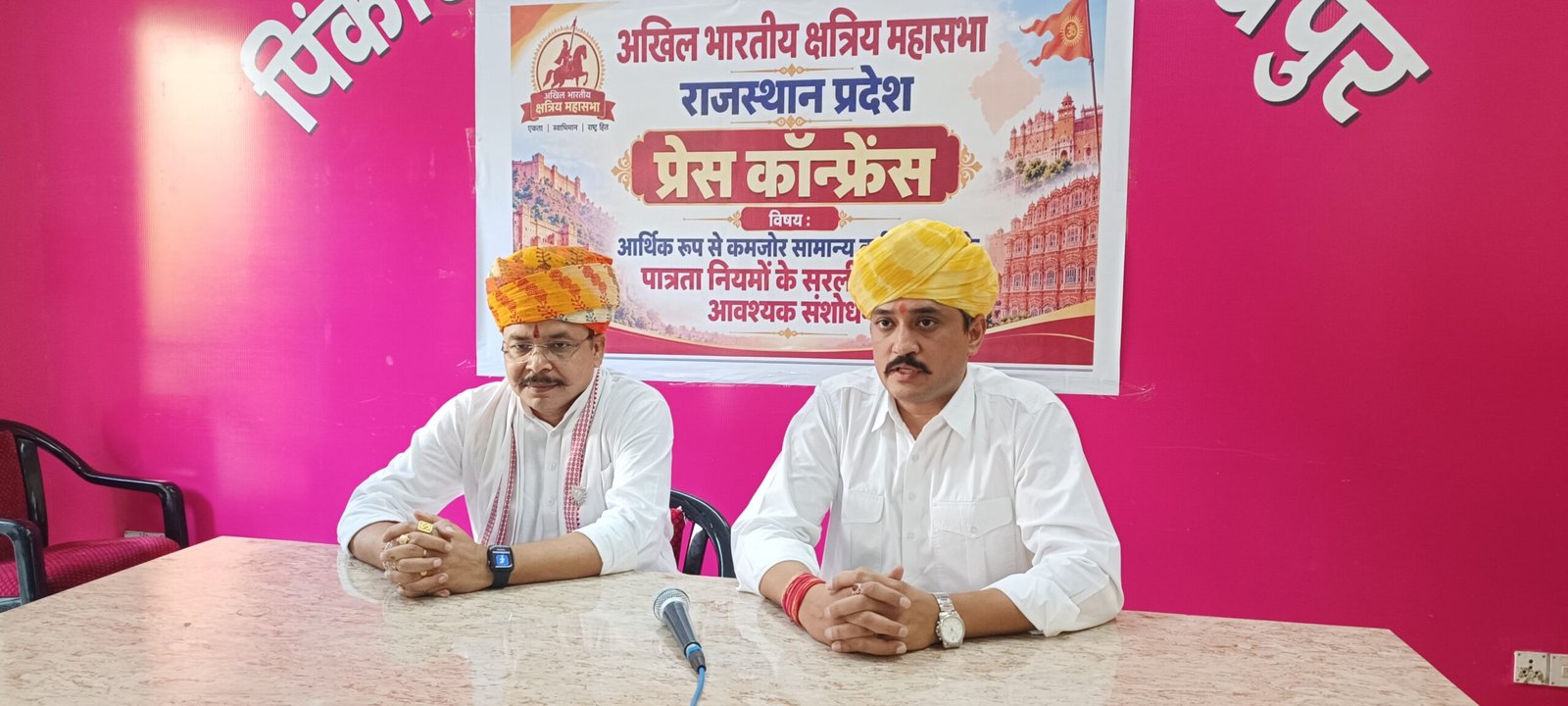
Jaipur, October 5, 2026: The Rajasthan Pradesh unit of the Akhil Bharatiya Kshatriya Mahasabha has called for the simplification and necessary revision of eligibility criteria under the Economically Weaker Sections (EWS) framework, particularly to address the practical difficulties faced by eligible families, students and youth from the economically weaker general category.
At a press conference held in Jaipur, the organisation put forward several suggestions aimed at making the EWS system simpler, more practical, transparent and responsive to regional conditions. The Mahasabha urged both the Central and State Governments to consider these issues sympathetically and initiate appropriate reforms.
EWS Eligibility Must Reflect Ground Realities
Addressing the press conference, Laxmesh Kumar Singh, Rajasthan Pradesh President of the Akhil Bharatiya Kshatriya Mahasabha, said that the core objectives of the organisation are “Unity, Self-Respect and National Interest.” He said the Mahasabha is committed to strengthening social harmony, protecting the dignity and rights of society, and working in the larger national interest.
He said the EWS issue concerns the future and opportunities of millions of economically weaker families, students and young people belonging to the general category. All social organisations working for the interests of the general category should come together and raise a united and constructive voice for simplifying and rationalising EWS eligibility criteria.
Singh pointed out that Rajasthan has constituted a commission to address issues concerning the general category and said that such an institutional mechanism can play an important role in examining demands, concerns and practical difficulties faced by the community.
He further stated that the Akhil Bharatiya Kshatriya Mahasabha would continue to stand firmly with all communities and organisations working positively in the interest of the nation, society and the larger public good. He emphasised that the organisation seeks to strengthen the voice of the poor, disadvantaged, vulnerable and needy sections by bringing all communities together.
Agricultural Land Criterion Requires a Regional Approach
Kunwar Harishchandra Singh Jasol, National Executive Working President (Youth) of the Akhil Bharatiya Kshatriya Mahasabha, said that economically weaker families in the general category are continuously striving to support their families and secure a better future despite financial challenges.
He said the process of obtaining EWS certificates should be simple, accessible and time-bound, with better coordination between the procedures for obtaining certificates at the state level and the requirements applicable to Central Government employment and other opportunities.
Jasol particularly raised the issue of the five-acre agricultural land criterion under the EWS asset eligibility framework.
He said Rajasthan’s geographical and agricultural conditions are significantly different from those of many other parts of the country. In districts such as Barmer, Jaisalmer, Balotra, Bikaner, Churu and Nagaur, as well as other predominantly rain-fed areas of Rajasthan, a substantial portion of agriculture depends on rainfall. Agricultural productivity and the economic value of land also vary considerably from one region to another.
“I come from the Balotra region myself and am well acquainted with its geographical and agricultural conditions. In these areas, the actual income derived from agricultural land and its economic value are determined by local circumstances. Therefore, the five-acre agricultural land criterion should not be assessed solely on the basis of acreage. Land productivity, availability of irrigation, geographical conditions and the family’s actual economic circumstances should also be taken into consideration.”
Need for a Comprehensive National Review
Jasol said that the EWS framework requires a comprehensive national review in view of the considerable geographical, agricultural and socio-economic diversity across India.
He suggested that a strong national-level commission should be established on the lines of the mechanism created in Rajasthan to comprehensively examine issues concerning economically weaker sections of the general category.
Such a commission, he said, should examine:
EWS eligibility criteria; The agricultural land-holding criterion; The process of issuing EWS certificates;Regional geographical and agricultural disparities;
Differences between irrigated and non-irrigated land;
Actual agricultural productivity and economic value;
Practical difficulties faced by eligible families; and
Other concerns relating to access to EWS benefits.
He suggested that subject experts, social organisations, relevant stakeholders and representatives of the EWS community should be included in the consultative process. Their recommendations could then form the basis for necessary reforms.
According to Jasol, such an institutional mechanism could help develop a simpler, fairer, more practical and effective EWS framework that takes India’s regional diversity into account.
Immediate Appointment to Vacant Chairperson’s Post in Rajasthan
Jasol also demanded the immediate appointment of a Chairperson to the vacant post of the Rajasthan commission dealing with general-category issues.
He said the Chairperson’s position is crucial for the effective functioning of the commission and that the vacancy limits its ability to discharge its responsibilities with full effectiveness.
He urged the Rajasthan Government to make the appointment at the earliest and ensure that the commission becomes fully functional so that issues, demands and practical difficulties concerning the general category and EWS beneficiaries can be examined seriously and addressed within a reasonable timeframe.
Confidence in the Modi Government’s Commitment to Economically Weaker Families
Jasol said that under the leadership of Prime Minister Narendra Modi, the country has witnessed extensive efforts over the past 12 years to bring poor, disadvantaged, middle-class and economically weaker families into the mainstream of development and provide them with greater opportunities.
He highlighted initiatives relating to education, employment, housing, healthcare, social security and economic empowerment, saying that the broader objective has been to ensure that the benefits of development reach people at the last mile.
In this context, he described the introduction of EWS reservation for economically weaker sections of the general category in education and government employment as an important and historic step.
He said economically weaker general-category families have faith in the Central Government and expect that the practical difficulties, regional disparities and eligibility-related issues emerging from the implementation of the EWS framework will now be examined with sensitivity and a broader perspective.
The objective, he said, should be to ensure that the benefits of EWS reach genuinely eligible economically weaker families, students and youth through a process that is simple, transparent and accessible.
Land Area Alone Should Not Determine Economic Status
The Mahasabha emphasised that the fundamental purpose of EWS is to provide opportunity, dignity and support for advancement to economically weaker families.
In keeping with this objective, the organisation said that EWS eligibility criteria should give appropriate consideration to:
Geographical conditions;
Irrigated and non-irrigated agricultural land;
Actual agricultural productivity;
Economic value of land;
The family’s overall financial circumstances; and
Local socio-economic realities.
A more nuanced approach, the Mahasabha said, would make the EWS framework more effective and responsive to genuine economic disadvantage.
Appeal for Government Action and Social Unity
The Akhil Bharatiya Kshatriya Mahasabha urged the Central and Rajasthan Governments to initiate a comprehensive consultation on simplifying and revising EWS eligibility rules.
It specifically called for:
1. Simplification and rationalisation of EWS eligibility criteria;
2. A review of the agricultural land-holding criterion, particularly in rain-fed and arid regions;
3. Immediate appointment of the Chairperson to the vacant Rajasthan commission;
4. Strengthening and fully activating the Rajasthan commission;
5. Constitution of a strong national-level commission to examine EWS-related issues across India; and
6. A transparent, practical and region-sensitive system for EWS certification and eligibility.
The Mahasabha also appealed to all social organisations working for the interests of the general category to come together on this important issue and play a constructive and effective role in ensuring that genuine economically weaker families receive the opportunities and support intended for them.
The organisation reiterated that unity is its strength, self-respect its identity, and national interest its highest objective.This version is structured as a media article rather than a literal translation, so it reads naturally for newspapers, news portals, press releases, and organisational websites.
About the Author