New Delhi, October 2026.
Building on a landmark inaugural session, the 10th edition of India Mobile Congress (IMC) 2026 gathered global industry leaders, policymakers, telecom operators and academia, to advance the forum’s defining theme of ‘Scale Without Boundaries.’ The day deepened strategic discourse across 6G testbeds, direct-to-device satellite connectivity and the monetisation of AI-native digital infrastructure, setting the stage for one of the most substantive programme days for the forum.
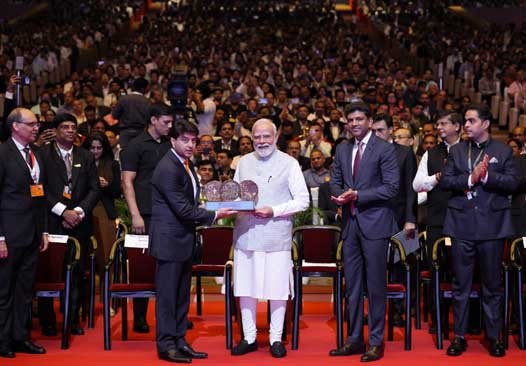
The 10th edition of India Mobile Congress (IMC) 2026was officially inaugurated today by the Hon’ble Prime Minister of India, Shri Narendra Modi. He lauded IMC for playing a pivotal role in uniting technology, research, industry, investment and ideas to serve humanity. Emphasising that technology scales only through trust, the Prime Minister highlighted India’s rapid evolution from a technology consumer to a global creator.
Addressing the forum in the inaugural session, Shri Jyotiraditya Scindia, Hon’ble Minister of Communications and Development of North Eastern Region, said, “India has demonstrated that digital scale need not come at the cost of affordability. UPI, Aadhar and digilocker demonstrate transformative power of affordable connectivity. Mobile phones have become bank branches and telecom networks have become India’s highway.By adding a billion people to the digital ecosystem, we will add innovators and entrepreneurs. Our responsibility is to ensure that geography or income does not limit their chances or opportunities.”
P Ramakrishna, CEO, IMC, said, “Prime Minister Narendra Modi’s address at the 10th India Mobile Congress reaffirmed IMC evolution beyond being a showcase for technology. His observation that the IMC has served as a mirror of India’s digital growth underscores how the platform has evolved alongside the country’s transformation into a digitally empowered nation. As IMC enters its next chapter, our focus will be on making the platform more outcome-driven and making Indian innovations reach global markets.
Organised by the Department of Telecommunications (DoT), Ministry of Communications, Government of India and the Cellular Operators Association of India (COAI), the landmark 10th edition of IMC is set to welcome over 1.5 lakh attendees from more than 100 countries.
Quotes from industry leaders and policymakers on Inaugural day of India Mobile Congress 2026:
Lt. Gen. Dr. S.P. Kochhar, Director General, COAI said, “As India Mobile Congress marks a decade, Prime Minister Narendra Modi’s vision of a digitally empowered India sets the tone for the next decade of transformation. India’s robust digital infrastructure has created a strong foundation for a future driven by connectivity, AI, 6G and emerging technologies.The next decade is about taking India’s digital journey from scale to global impact, positioning the country as a creator and trusted technology leader for the world.”
Magnus Ewerbring, CTO – APAC, Ericsson said, “Networks are becoming increasingly intent-driven, operators specify the outcome or service they want, and the network dynamically determines how best to deliver it. This will be critical as operators look to offer more differentiated and personalised services, including on-demand network capabilities tailored to specific customer needs. Moving from pre-configured network resources to dynamic, intelligent configuration will require a fundamental shift in how networks are designed and operated.”
Luciana Camargos, Head of Spectrum, GSMAsaid, “We need a regulatory framework that enables the service while ensuring that terrestrial networks are protected from interference. Device availability is another important consideration, particularly where satellite services rely on specific spectrum bands. Governments and industry therefore need to work together to address the barriers to adoption, including affordability and digital literacy, so that connectivity can reach those who need it most.”
Tarun Chitkara, VP – Regulatory, Bharti Airtel said “In critical areas, such as border regions or hilly areas, where there is a genuine requirement for connectivity but very little population to serve, Direct-to-Device can make a real difference. I see three important requirements: the right regulatory framework, technical integration and, finally, commercial considerations. The infrastructure is ready, and technical integration can be addressed. What we need now is a regulatory framework that enables these services and creates a favourable environment for operators to bring connectivity to places where conventional infrastructure may not be commercially viable.”