New Delhi, 18 February 2026.
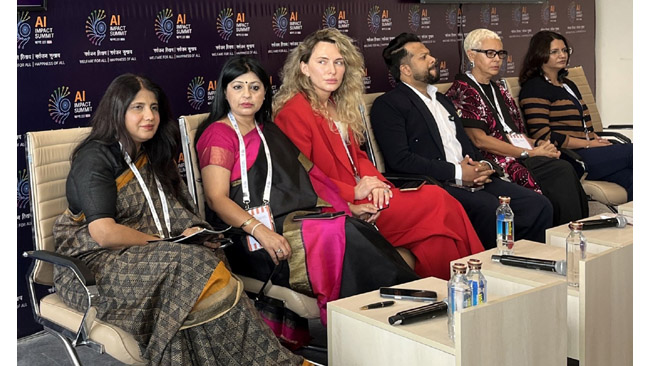
‘Gender Parity through innovation and entrepreneurshipis a critical driver for Democratization of AI’, was a key takeaway at a global panel convened by BRICS CCI WE, the Women Empowerment Vertical of the BRICS Chamber of Commerce & Industry, at Bharat Mandapam at the India AI Impact Summit 2026. The discussion, with focus on “From Implementers to Innovators: Shifting the Narrative Towards Women Entrepreneurship in AI”, placed women at the forefront of enterprise creationand ecosystem leadership.The session brought together global leaders, entrepreneurs, investors and ecosystem builders to discuss how AI can be democratized through inclusive participation and women-led innovation.
Giving the welcome address, Mr. Sameep Shastri, Vice Chairman, BRICS CCI, emphasized India’s growing global role in AI and the importance of inclusive innovation.“India today is emerging as a strong voice in the global AI ecosystem. AI must not only be powerful but inclusive. As India takes on the BRICS Presidency in 2026, we aim to strengthen cooperation in technology, digital innovation, entrepreneurship and responsible AI development.”
Opening the discussion, Ms. Ruby Sinha, President, BRICS CCI WE (Women Empowerment) and Founder, sheatwork, set the tone by reframing the current phase of AI evolution. “AI is no longer a future technology or a buzzword. It is embedded in the infrastructure of the current landscape. India’s AI journey is drawing attention globally for its scale, innovation and impact. The focus of this on-going AI Summit 2026, as envisioned by our honorable Prime Minister, is democratization of the usage of technology, with pointed focus on gender parity. For decades, women were simply asking for access. Today, we are moving from asking for a seat at the table to designing the table itself.”
Highlighting women’s rising influence in technology-led ventures, Ms. Amrita Chowdhury, Co-Founder & CEO, Gaia said, “We stand at a defining moment in entrepreneurship and technology. While women lead nearly 20 percent of startups and MSMEs, their influence is rising steadily. Women are not only adopting AI but actively building and steering its applications across FinTech, retail, supply chains and urban infrastructure. Innovation must reflect lived realities. By embedding gender-responsive data into AI systems, we can create mobility, cities and solutions that are safer, smarter and inclusive.”
Bringing a global cooperation lens, Ms. Elvira Chache, Executive Director, AI Regulation and International Cooperation, Sberbank, added, “It is critical for women to be present not just at the entrepreneurial level but also at the legislative level to bridge gender disparities. Countries from the Global South need to form communities for women innovators so they can share resources, including data. We are witnessing a gradual shift toward women entrepreneurship in AI. Industry bodies and institutions are now providing grants and seed capital to innovators, which is essential for scaling impact.”
From the startup ecosystem perspective, Mr. BibinBabu, Founder, GrowQr AI and Co-Founder, Payciosaid, “Women are already making their presence felt in the AI space. What I see in many women-led startups is a strong focus on durability and clarity of the problem they are solving. They validate early, optimize consistently, and focus on revenues rather than chasing valuations. In agentic AI, context and responsibility matter deeply, and women founders are bringing that long-term thinking into the models being built. Women don’t need permission to lead in AI. We need what you (women) are building. Just go out and build.”
Offering a Global South perspective, Ms. Nagila Guimaraes, Director of Global Strategic Partnerships, Instituto +Mulheres; Founder & Co-curator, AI Rio 2026, said, “Democratizing AI means ensuring that women are not only trained to use AI tools but are supported to build companies, influence policy and lead international collaborations. In Latin America and across BRICS nations, we are seeing strong momentum among women founders. What we need now is cross-border mentorship, shared research, and access to funding pipelines that allow women-led AI startups to scale globally.”
At the grassroots innovation level, Ms. Shivani Singh Kapoor, Co-Founder, ThinkStartup, presented compelling data from youth innovation programs.“Over the last five years, our pan-India innovation competition has seen girls’ participation reach 45 percent, delivering AI-driven solutions from elderly wearables to drone-based bio-decomposers. To transform these builders into tomorrow’s entrepreneurs, we need school and college interventions, market pathways and structured vertical challenges where India’s creativity can compete at the global AI edge.”
In her concluding remarks, Ms Ruby Sinha, President, BRICS CCI Women Empowerment and Founder, sheatwork highlighted the transition from participation to leadership – positioning women not merely as adopters of AI tools, but as architects of AI ecosystems, calling for inclusive innovation in AI.
The discussion, which was also attended by Ankita Sachdev, Jt Director, BRICS CCI and other delegates from BRICS CCI, underscored a critical shift. AI is no longer a speculative technology or an experimental tool. It is infrastructure. The question is no longer whether AI will shape economies, but who will shape AI.